Invasive Species Alert: Atlas Moth Found In United States For First Time

Readers of this blog will know we have spent a lot of time on invasive species worldwide. Invasive species come in all sizes and varieties and much of what they have in common is damage and displacement.

close up photography of atlas moth
An Atlas moth. If you look closely at the tips of the wings they resemble snake heads. This is thought to confuse and alarm predators.Photo by John on Pexels.com

Yesterday we once again discussed Florida Burmese pythons which are truly wreaking havoc in the Florida Everglades. In some areas small to mid -size mammals may have decreased by 98 percent. Hippos in Ecuador ,and feral housecats in Poland, are also on the list of damaging and potentially dangerous creatures let loose where they don’t belong.

Some hitch hike, some are released by irresponsible owners, and until recently some creatures were imported to solve one problem. Only to create another as did the mongoose in Hawaii. That ferocious predator was brought in to control rats in sugarcane fields. It ate the rats – and many other valuable and beloved creatures as well. Today it is endemic in much of the island state.

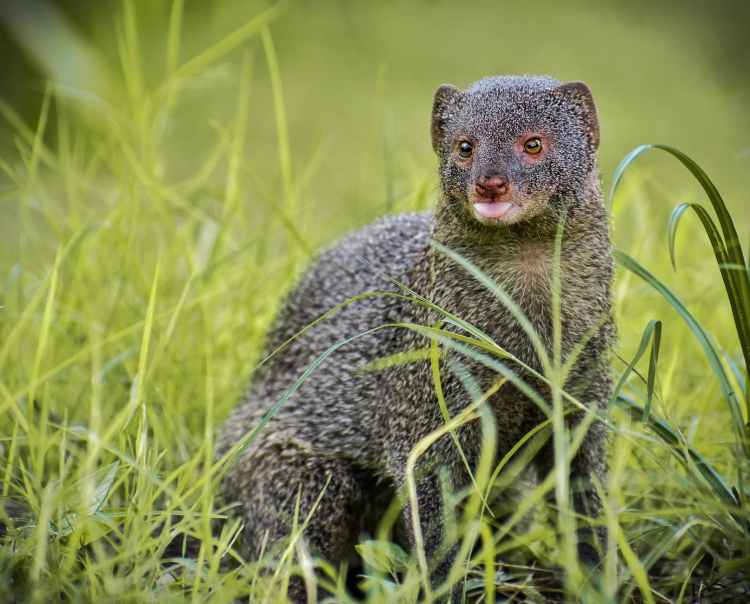
A mongoose is a fierce small weasel. It was brought to Hawaii to kill rats but decimated other creatures as well.Photo by Omkar Vinchu on Pexels.com

Today the topic is a federally controlled insect pest the Atlas moth. One of the very biggest moths in the world. It has a wingspan of nearly 10 inches. Only two other known moths are bigger. So far only one has been spotted in Washington state. That state is also on the lookout for so-called “murder hornets.” Those hornets have been renamed as “northern giant hornets” and have been spotted in Canada as well as Washington.

The adult Atlas moths are harmless, even lacking mouths, but the juveniles are destructive to fruit trees and other agriculture. That is why authorities are concerned. According to Smithsonian Magazine, authorities believe someone was illegally raising the moths and selling cocoons. As part of an illegal pet trade. Federal law prohibits ownership, sale or raising of these moths. This moth is thought to have escaped. The Washington State Department of Agriculture is concerned that a breeding population might exist. Residents are urged to look for the insects and capture or photograph them and contact agriculture authorities. Since there apparently is an illegal trade in the insects, residents of other states are asked to be on the lookout too.

The problem is enormous. The United States Department of Agriculture maintains a list of plants, animals, insects, viruses and other beings that are invasive in this country alone. The list has nearly 200 creatures on it.

The mongoose is well known for its ability to kill large venomous snakes. n24_w1150 by BioDivLibrary is licensed under CC-PDM 1.0

Increasingly, nations are looking to scientific controls for invasions by creature large and small. A recent breakthrough in tick control may point the way.

Florida Python Challenge 2022 Is Complete, May Not Be Making A Huge Impact, But Python Control Efforts Continue

Almost 1000 python hunters signed up for this year’s Florida Python Challenge which ended August 14. The final results are not in but it remains clear that however many were taken, many remain.

Alligators are one of the most well known of theFflorida animals and they eat some pythons. Photo by 3K on Pexels.com

Meanwhile, although the situation is grim there are signs of human and animal pushback against the invasive species which may have killed up to 98 percent of small to medium sized mammals in some parts of the Everglades.

The exact number of pythons is unknown but the high-end estimate is about 300,000. The southeast Asian natives arrived in Florida as part of the exotic pet trade some decades ago. Irresponsible owners abandoned some of the snakes. Since they can reach 22 feet in length their danger to local wildlife is obvious.

Bobcats are usually on the losing end of python encounters but some eat python eggs. Photo by Pixabay on Pexels.com

In August, 1992 a natural disaster compounded the problem. According to History.com Hurricane Andrew devastated Florida and destroyed a breeding facility releasing thousands of Burmese pythons into the region. Now man and nature are seeking to put the toothpaste back in the tube.

A destructive hurricane is said to have destroyed a snake breeding facility in Florida, releasing thousands into the wild. Photo by GEORGE DESIPRIS on Pexels.com

The Florida Python Challenge is an annual and growing event which offers prizes to participants who catch the biggest python. The event is state supported and tries to combine hunting with education and conservation. About 950 hunters participated this year.

The challenge is one of a number of efforts the state is making. Pythons can be hunted year round in Florida and other hunting restriction have been eased. There are efforts to get diners to eat pythons. The public is encouraged to report them and the state works to catch them. About 100 full time contractors hunt pythons for the state. Although the hunters are generally paid paid minimum wage they receive bonuses. The bonuses are based on the size of the snake and can add up to hundreds of dollars per snake, according to History.com.

So far, it doesn’t appear the efforts are a striking success. According to NPR the challenge has done little to cut back the population. But the hunters NPR interviewed told the outlet they feel they are making a difference. According to History.com the hunters have removed about 4,000 snakes from the wild, about 2,000 females. The females are capable of multiple pregnancies in a 20 year lifetime. They lay 50 to 100 or more eggs at a time. That makes it hard to argue that there has been no impact. But it also makes clear the size of the problem.

Nature, of course is not entirely defenseless. Alligators will eat pythons and vice versa. It is usually the larger of the two that wins. Recently, Newsweek reported on a cottonmouth that ate a small python. Cottonmouths are poisonous snakes native to Florida. Since many snakes eat other snakes it is likely some number of python hatchlings don’t reach maturity. Large birds and other creatures are also capable of eating smaller pythons.

We reported on the discovery that bobcats (whose population has been severely impacted by pythons) have been seen eating python eggs. Bobcats face a second serious problem, Rabbits are normal prey and as many as 77 percent of rabbits are being eaten by pythons. With nothing to eat bobcats may vanish from the area.

Science may well hold the key to the best control efforts. Hunters are already using male “scout snakes” with implanted trackers to locate females. Sometimes they find them on the nest and are able to prevent the release of 50 to 100 or more nestlings. Python sniffing dogs are being considered. More exotic ideas, such as genetic manipulation of snakes is also being investigated. Genetic manipulation would take a number of forms. It could result in infertile eggs, or the birth of male pythons only.

Australia is a nation continent plagued by invasive species including housecats and rabbits. The nation is also considering genetic warfare. Such genetic efforts have been very successful with insects but challenges for larger animals are great.

A

Wildlife Learning Center In Sylmar Expands Hours, Returns To Schools Receives Golf Fund Raiser

In a return to Post-Covid normalcy The Wildlife Learning Center (WLC) in Sylmar has made three important announcements. All three signal a possible end to a financial drought impacting wildlife rescue organizations world wide. Restrictions and mandated closures forced wildlife rescue institutions to try to find ways to survive with severely reduced funding.

WLC has actual scorpions on display. Photo by Soly Moses on Pexels.com

First, the small but popular zoo/rescue center has returned to 10am to 5 pm hours Monday through Friday. Due to Covid -19 hours were severely restricted and actual reservations were needed to visit. Tickets can still be pre-ordered, and pre-ordering is recommended, but the center is now open for walk-in visitors.

Gila Monsters and Mexican Beaded Lizards are the only two lizards with poison dangerous to humans. A Gila Monster is part of the WLC animal family

Second, The WLC has been active in school outreach. Staff would bring selected animals to local schools for nature talks about the center’s animals. Those visits were suspended due to Covid-19 but have resumed. The center has a variety of birds, reptiles, mammals and invertebrates from all over the world. Many of the animals are rescues, others have been rehabilitated but cannot live in the wild.

Finally, WLC is participating in a fund raising golf tournament Sept 9 at Brookside Golf Course in Pasadena. DocWalks4Animals will feature a day of golf, a banquet and a silent auction. Doc Walks4Animals is the creation of a pediatric urologist who walked for animal support issues earlier in the pandemic. She walked more than 100 miles and later created the organization to support wildlife. Her efforts came as a realization that wildlife rescue and conservation efforts had been drastically impacted by Covid restrictions.

Another form of scorpion is the scorpion asana. Photo by Miriam Alonso on Pexels.com

On her website Dr. Monica Metzdorf MD says

“Proceeds from this charity tournament will benefit the Wildlife Learning Center (WLC) located in Sylmar, CA.  Founded to provide public education in the life sciences, conservation and our environment, the WLC is a zoological park nestled in an old olive grove in San Fernando Valley. Funds will go toward the purchase of an on-site ultrasound machine and other needed medical equipment for the care of the animals. Visit their website to learn more about the many exotic animals that they heal and house: Wildlife Learning Center“

WLC was founded by Paul Hahn and David Riherd and operates as an accredited zoo and rescue center. The animals at the center range from Asian forest scorpions. to African bullfrogs, Gila monsters and eagle owls, to sloths, servals, bobcats and Canada lynx.

Servals are African cats famed for their ability to hunt birds. A serval, such as the one at WLC,, can jump about 12 feet high and perform a 15 foot long jump. Photo by Egor Kamelev on Pexels.com

There are other serious difficulties facing zoos and wildlife rescue centers around the world, including the Ukrainian war. That war has not only impacted Ukrainian zoos and rescue organizations it has strained facilities in neighboring countries.

Prior to the war Ukrainian wildlife had been rebounding in the region around the Chernobyl nuclear accident. Because of fighting it is unclear what the status of wild animals is.

Jaguar Nicknamed “El Jefe” Spotted In Mexico After Disappearing From Arizona; Suggests Jaguars Finding Ways To Cross Border Despite Hazards

A well-known male jaguar first recorded in Arizona has been spotted in Mexico. “El Jefe” as the cat is known, had disappeared from Arizona in 2015 and was feared dead.

He is estimated to be about 12 years old. which is toward the end of the life span of a wild jaguar. Jaguars in zoos can live to about 2O years. El Jefe, “The Boss” in Spanish, was nicknamed by Tucson, Arizona school children. At one time he was probably the only Jaguar resident in Arizona.

Not only are jaguars bigger than leopards, they have “spots within their spots” also known as rosettes. This can be seen on the back and flanks of this cat tPhoto by Nick Núñez on Pexels.com

Jaguars have unique patterns of rosettes, often called spots. Since no two individuals are alike photos from trail cameras can provide definitive identification. El Jefe was caught on cameras set up by PROFAUNA a Mexican conservation organization. Their motto is “We Live To Conserve.” The Northern Jaguar Project (NJP), Arizona’s Game and Fish Department (AZGFD) and Wildlands Network all agreed that the cat seen in Sonora is “El Jefe.” A press release said there is “no doubt” it is the same cat. The NJP specifically targets jaguars in the northern Mexico and southern Arizona region for conservation.

Jaguars and cougars, or mountain lions, are the two largest cats in the America’s. Jaguars tend to be a bit larger. The biggest jaguars weigh in around 300 pounds. The biggest knowns cougars have been weighed at 220 pounds. Cougars can be found from Canada all the way south to Argentina. They have the longest north south range of any cat. Jaguars are found mostly in the Amazon but scattered population exist, There are populations as far north as northern Mexico and south of the Amazon.

Jaguars are sometimes confused with leopards. In addition to the difference in size and pattern of coat there are some other key differences. Jaguars are stockier and more muscular and have broader heads and shorter tails. Although both leopards and jaguars can swim, leopards tend to avoid water. Jaguar spend lots of time in the water. Jaguars are quite bold and will attack animals larger than themselves. Leopards avoid conflict with bigger animals. Jaguars can climb, but not as well as leopards whose longer tails give them an advantage in trees. A leopard can weigh up to 165 pounds, just about half the weight of a jaguar.

There are efforts in Central and South America to re-connect jaguar habitat and reintroduce them to areas from whence they have been exterminated. Efforts to “re-wild” jaguars are also under way.

A reclining leopard. Note the difference in spot pattern . Photo by Pixabay on Pexels.com

Recently we have reported on efforts to re-introduce jaguars into Arizona from Sonora, Mexico where breeding populations exist. The fact that El Jefe was able to return to Mexico from Arizona suggests that animals can find ways across the border. The construction of highways and efforts to secure the border are hindrances to animal movement.

Scientists Seek To Reverse Extinction Of Tasmanian Tiger; But Hurdles Remain As New Animal Will Be A Hybrid Facing New Challenges

Extinction may not be forever anymore as scientists have announced a serious effort to reverse the extinction of the Tasmanian tiger. The tiger, or Thylacine, probably went extinct in 1936. In that year the last captive tiger died. He was named Benjamin and died in the Hobart Zoo.

There is some doubt about whether Benjamin was in fact the last tiger, as some researchers are hoping against hope that a few still live in the wild.

Thylacines were persecuted because people thought they were killing livestock.n222_w1150 by BioDivLibrary is licensed under CC-PDM 1.0

The tiger was both the ap ex predator of the continent and a marsupial which has implications for the resurrection of the species. Marsupials are pouched mammals and most live in Australia and New Guinea. There are three in the Americas. Only the opossum lives in North America.

A group of ambitious scientists has announced plans to “de-extinct” the predator by creating a hybrid that will be as close as possible to the Thylacine.

The effort will involve cutting edge technology and has implications for the future of marsupials. Marsupials are under threat in Australia from extensive fires and from invasive species including housecats. Many marsupials are relatively helpless and fall easy prey to introduced predators. In fact a DNA bank has been established to protect marsupials. The banks will take advantage of this project and future advances.

Unlikely as it may seem the fat-tailed dunnart may be the key to resurrection of Tasmanian tigers. Photo by Trevor Pescott,

The first step is to sequence the DNA of the thylacine. That may prove difficult as the samples are old and may be degraded. The next step will be to use the dunnart as a surrogate. A dunnart is a predatory marsupial and the closest living relative to the thylacine.

The thylacine sequence will be edited with the dunnart sequence to recreate a hybrid Thylacine. The tiger was about the size of a coyote and the dunnart is the size of a mouse. This should not pose the obvious problem for using dunnarts as surrogates. Marsupials deliver tiny offspring, some the size of a grain of rice. They develop in the mother’s pouch. Tiny thylacine hybrids should be able to be borne by dunnarts and raised with human help.

Assuming the project reaches this level of success problems remain. The new creature may not be truly viable for a number of reasons. If viable, reintroducing it into Australia also poses difficulties.

Andrew Pask, a professor at the University of Melbourne and head of its Thylacine Integrated Genetic Restoration Research Lab, who is leading the initiative, spoke to CNN:

“Our ultimate goal with this technology is to restore these species to the wild, where they played absolutely essential roles in the ecosystem. So our ultimate hope is that you would be seeing them in the Tasmanian bushland again one day,” he said.

The fat-tailed dunnart is much smaller than an adult Tasmanian tiger, but Pask said that all marsupials give birth to tiny young, sometimes as small as a grain of rice. This means that even a mouse-size marsupial could serve as a surrogate mother for a much larger adult animal like the thylacine, at least in the early stages.

Reintroducing the thylacine to its former habit would have to be done very cautiously, Pask added.

“Any release such as this requires studying the animal and its interaction in the ecosystem over many seasons and in large areas of enclosed land before you would consider a complete rewilding,” he said.

ed to protect against extinction from fires,” Pask said via email.

“However, we still lack the technology to take that tissue — create marsupial stem cells — and then turn those cells into a living animal. That is the technology we will develop as a part of this project.”

Sacramento Wildlife Census Shows How Closely Urban Dwellers Live With Wild Animals

Sacramento and Los Angeles are very different cities, but one thing the two regions share is the fact that much wildlife has habituated itself to human presence.

KTXL Fox 40 quoted City of Sacramento Animal Care Services as listing the following wildlife living even in the city center: raccoons, opossums, deer, skunks and coyotes.

Because of some regional differences the list for Los Angeles may even be a bit longer.

Raccoons inhabit all of the United States except Alaska and are quite common. They weigh up to 35 pounds and can be seen walking in family groups. There are a number of species of raccoons, but the northern raccoon is the species in California

Raccoons have become true urban predators eating their way through neighborhoods and feasting on things we leave behind including pets. Photo by David Selbert on Pexels.com

According to Fox 40 : “:Raccoons tend to live in attics, crawl spaces, hot tubs, decks, tool sheds, and storm drains and drink out of pet water bowls, swimming pools, and ponds. Raccoons can be found roaming neighborhoods at night looking for food. They eat insects, fruits, vegetables, acorns, seeds, fish, and small mammals. “

Those small mammals can include cats and dogs with kittens being most vulnerable. Their pattern in Los Angeles is quite similar. I have seen them come in and out of storm drains.

California has two types of skunks, spotted and striped. Striped skunks are the most likely to be seen in urban areas. Like raccoons they have little or no fear of people as the two species have lived close to humans for generations. Skunks may be less noticeable than raccoons because they tend to eat insects and rodents. They may, however, indulge in garbage, which is plentiful.

Coyotes are also highly urban having found their ways into most Californai cities. They now show wariness but little fear of humans. Photo by Frans van Heerden on Pexels.com

Very little needs to be said about coyotes. They are everywhere. They are a threat to raccoons and skunks as well as rodents and birds and sometimes eat fruit and vegetables. They are a distinct threat to pets and can kill and eat goats and other livestock. They are habituated to humans and not too afraid of us.

Bobcats are part of the lynx family and are found in much of California. Human expansion is bringing them into closer contact with humans, Photo by Alex Burr on Pexels.com

Deer are found throughout most of California. California has two subspecies of mule deer. Columbian black-tailed deer and California mule deer. They are named for their superficial resemblance to mules. Deer are found right on the edge of our most urbanized locales in Sacramento and in Los Angeles.

Los Angeles may be slightly different than Los Angeles because our suburbs and even small cities can accommodate bobcats, bears and cougars or mountain lions.

These three animals are increasingly in the news as human development moves into wild lands. They are then forced to try and find a living much closer to people than they would like.

Recently, we have posted on cougar cubs found under a park bench in Thousand Oaks, the threat to bobcats by traffic and common garden poisons. We have even noted how the bear population is expanding. Bears routinely wander into neighborhoods bordering our mountains. They may, in fact, be moving into Boston from rural Massachusetts,

Decades Of Protection Pay Off As The Italian Wolf Population Rebounds And Grows After Near Extinction

Wolves are loved and hated all over the world. Recently we reported on trouble in the United States where persistent efforts to reintroduce wolves to their former range are met with mixed success and much hostility.

We also reported on problems in Asia where wolves in Tibet appear to be expanding their range. That delights some and enrages others.

Wolves are a bit f a Rohrschach Test. Do you see a Doglike being or a Destructive Pest?Photo by Steve on Pexels.com

Today’s focus is Italy. A recent count indicates that 3,300 wolves make the peninsula their home.In the Appenine and Alps mountain ranges wolves appear to be increasing in number. Italian wolves may be met with a warmer welcome than elsewhere. Some see them as a natural solution to problems caused by an explosion in the wild boar population. Wild boars are roaming the streets and countryside near Rome and other cities.

Wild boar are on the menu for both humans and wolves. They will eat almost anything, are very fertile and quite destructive. Photo by Dario Fernandez Ruz on Pexels.com

The Big Bad Wolf was once common throughout Europe. Various subspecies of canis lupus, the gray wolf, were found throughout western and eastern Europe. Wolves and humans were enemies for centuries. Wolves are determined and smart. Extermination took centuries. They were hunted to extinction in the British Isles by 1800.

On the continent wolves were the subject of constant assault. The old Soviet Union attempted to fully exterminate them. The animals were reduced to remnant populations until public attitudes started to change in the 1960’s and 1970’s. Russian wolves are still unprotected, but those surviving in most of the rest of Europe are protected and many populations are at least stable, Many countries pay compensation for livestock killed by wolves.

The Italian Alps are prime wolf habitat and the packs are apparently moving into surrounding countries.Photo by Julius Silver on Pexels.com

Italy counted its wolves in 2020 and 2021 the count was conducted by ISPRA The National Institute for Environmental Protection.

According to the website Weird Italy (linked above) ISPRA was thorough in its technique:

AreaEstimate
Alpine region area946 (822 – 1099)
Italian peninsular area2388 (2020 – 2645)
Total3307 (2945 – 3608)
A table showing estimates of Italian wolf population (Weird Italy)

“The monitoring was conducted by dividing the national territory into cells of 10×10 kilometers and carrying out two separate analyzes for the Regions-Autonomous Provinces of the Alps area and the Regions of peninsular Italy. The presence of the wolf, says Ispra, “has been documented by 6,520 photographic sightings with camera traps, 491 ungulate carcasses preyed upon by the wolf, 1,310 tracks, 171 dead wolves, as well as by 16,000 excrements found on the ground. 1,500 genetic analyzes were conducted which made it possible to identify the species. A total of 85,000 kilometers were traveled on foot to collect the data necessary for the investigation “.

The results show that wolves inhabit almost all of the suitable habitat on the peninsula.

Sicilian wolves were eradicated in the 20th century. No reintroduction plans were mentioned.

Wildlife Attacks In Japan Increase As Villages Shrink And Animal Population Increases

Japan is seeing more and more frequent attacks on humans by monkeys, bears and wild boars. The number of wild animals is also increasing and the problem seems to have several causes. It is also reported that dolphins sometimes bite humans on Japanese beaches.

Macaques are strong and highly intelligent. When they start raiding houses for easy food, trouble ensues. Photo by Klub Boks on Pexels.com

Although some suggest “climate change” is a key part of the problem, others point to decreasing rural populations which appear to be leading to a population boom among wild animals.

According to Deutsche Welle some blame long term weather changes for the increase in conflict. They quoted Mariko Abe of the Nature Conservation Society of Japan.

Americans may think of dolphins as smiling mammals but they are sometimes biting people off the coasts of Japan. Photo by HAMID ELBAZ on Pexels.com

“For the last decade or so, the rainy season that used to reliably last for around a month from mid-June has become shorter and delivered less rain,” she said, adding: “And this year it has been extreme.”

“There was cloud cover during June, but not enough rain and now we are seeing record high temperatures across the country.” This results in less food for the animals.

Although that may be true, there is more to the story. There have been a record number of bear sightings, over 13,000. As in the United States, big city suburbs have been steadily inching into wild animal habitat. An increased bear population is thus forced to cohabit with encroaching humans. Monkeys and wild boars face the same problem.

Wild pigs are powerful predators and they reproduce quickly. Photo by Pixabay on Pexels.com

Another part of the puzzle was supplied by Kevin Short. Short is a professor at the Tokyo University of Information Sciences. Deutsche Welle quoted Short:

“In the past, these villages used to work as a sort of buffer zone between the forests and the suburbs and villagers would cull the animals that took their crops and so on,” he said.

“With villages losing all their young people and gradually shrinking, there are fewer people to stop the wildlife from taking over.”

“Japanese macaques, for example, are very intelligent and once they realize that they do not need to fear humans and that they can effectively bully us, then that spreads through the troupe very quickly.

“They have also learned that the suburbs of Japan’s towns and cities provide attractive and easy sources of food,” he underlined.

The disappearance of villages and hunters means a population boom for the animals, and a loss of the fear of humans.

Abe made a comment already familiar to suburban Americans

“The bottom line is that these are wild animals in their natural habitat,” said Abe. “Humans are intruding into their spaces, they are not pets and people cannot just play with them. People need to learn to stay away from wildlife.”

The problem is severe with macacques attacking children and raiding homes, Wild boars rummaging around towns and cities and bears foraging for food. There are also reports of dolphins biting people along crowded beaches.

We have reported on similar problems around the world. Italians are facing what amounts to a war with wild boars. In the United States black bears are moving into the suburbs of Boston. In India many areas have conflicts ongoing between monkeys dogs and humans.

The problem is severe:

.

Ja

a

a

Wolves Vs Ranchers: Ongoing Battle Heating Up In Colorado, Other States

At one time there may have been as many as 2 million wolves in the continental United States. Hunting and persecution reduced the number to a few hundred by 1960. Most of them were restricted to Michigan, Wisconsin and Minnesota.

Efforts to reintroduce wolves to much of their former range iresult in opposition by ranchers and cattlemen. Photo by Pixabay on Pexels.com

Almost universally reviled in 1900 wolves began attracting a following of conservationists and other activists. By the 1970’s attitudes toward wolves began to change. Favorable attitudes were more prevalent the farther away from wolves one was. Rural residents and ranchers were not and still largely are not fans. City dwellers, on the other hand, were far more open to conservationist arguments.

Starting in 1995 wolves began to be reintroduced in the American west. Reintroduced packs began to spread from Yellowstone National Park after reintroduction, Today there are populations in the park, in Wyoming, and in Idaho. There are also packs in California, Oregan and Washington. The number is over 1,000 in the west. But everywhere wolves go, anger follows.

Animals as powerful as bison can be taken by wolves. Photo by Pixabay on Pexels.com

The latest case in point is Colorado. Colorado voters narrowly passed a wolf reintroduction bill with a deadline to reintroduce the animals by 2023. About 50.3 percent of state residents supported the idea. The biggest bases of support were in urban areas, and ranchers are angry.

Supporters of wolf reintroduction view the animals as keystone elements of a healthy ecosystem. They use Yellowstone Park as an example. They say the park vegetation has changed, behavior of prey species has changed and the park have overall changed for the better.

The argument is that wolves kill and eat sick and injured animals, lower coyote populations and in general bring the wildlands into a natural balance.

Ranchers say wolves harass cattle leaving them fearful and affecting their health. Photo by Pixabay on Pexels.com

The opposition is usually led by ranchers and hunters. Hunters fear competition for prime specimens of game. They believe wolves kill prime animals. Ranchers fear loss of livestock as well as valuable dogs and other domestic animals.

Wolf supporters say the loss of livestock to wolves is minimal and that there are programs to reimburse them for loss. Ranchers say that while that is true one has to prove the animal was alive when attacked and that wolves did it. Wolves can eat a cow down to the hide in a matter of hours and often eat the hide too. That, they say, makes proof almost impossible. The compensation programs pay the value of the animal at the time of death. An animal killed in winter is lower value than one ready for market ready for sale.

Another problem is statistical. While it may be exactly true that wolves only kill a small percentage of animals that number may be a large one and it is not evenly distributed. We recently reported on a rancher who lost 143 sheep to two wolves. It may be a freak example, but the wolves stampeded the sheep and they died from the results of the stampede.

The death of those sheep is in line with what industry periodical Beef Magazine argued. Wolves harass cattle and other animals, keeping them fearful. That results in poor feeding, fewer pregnancies and other disruptions. In one case the rancher had to keep cattle away from a river system due to water purity regulations. That meant he had to pasture them nearer to wolves. He told the magazine wolves stalked and harassed the cows which wouldn’t eat and didn’t behave normally.

In one incident in Idaho two wolves are said to have panicked a flock of sheep into stampede. 143 sheep died in the stampede.Photo by Jonathan Borba on Pexels.com

All over the west the battle continues as wolves have been poisoned in Oregon, entire packs have disappeared in California, and hunters wait outside Yellowstone for wolves to roam out of protection.

Meanwhile, at least one researcher thinks both sides need to take a closer look at facts and check the emotions at the door. Wolves are not the “Silver Bullet” to restoring the pristine nature of an imagined wilderness Eden. Nor are they the salivating monsters simply waiting to kill every calf, lamb or foal.

They are simply an important predator with a right to exist and a place in the ecosystem.

Authorities In Mexico Seize About 200 Big Cats And Other Animals, Sanctuary Owner Disputes Abuse Claims

Mexico City police serving warrants recently seized about 200 exotic animals including 177 lions from a sanctuary on the capital’s south side.

Authorities allege that the animals were abused and mistreated, but the sanctuary owner says videos of the raid were “out of context” and that the sanctuary was rescuing animals and most were healthy.

Lion numbers in the wild are declining but thousands are in captivity including lions bred for slaughter Photo by Pixabay on Pexels.com

The raids took place at Black Jaguar White Tiger Sanctuary. On the sanctuary website its operator, Eduardo Serio, says the sanctuary is dedicated to rescuing abused animals. Serio says that most of the animals were rescued starting in 2015 after Mexico banned animal acts and a great number of animal attractions closed.

The raid was conducted after The Attorney General’s Office for Environmental Protection obtained a warrant and Mexico City police conducted the raid. Authorities said the sanctuary was not operating on land sanctioned for animal sanctuary use and that the animals – lions, tigers, jaguars, lynxes servals and others – were abused. The animals allegedly were dehydrated and ill, some unable to walk.

Despite some recent gains there are probably only 5,000 tigers left in the wild. Perhaps twice as many live in the Unites States in zoos, sanctuaries and private hands. Photo by GEORGE DESIPRIS on Pexels.com

Serio disputed the allegations. He was quoted in Englands’s Daily Mail:

“Eduardo Serio, the founder of the reserve, told local media that he had rescued rsome of the animals from some of the 500 circus venues in the country after the government outlawed their use in shows in 2015.

At least 90 to 95 percent of the animals were at their weight limits, he said, but the ones that were highlighted in the videos ‘which look scared, were animals that we were trying to rescue, (the videos) were taken out of context.’

Some jaguars were seized in the Mexico City raid. Native to Mexico there are efforts to strengthen their numbers and hopes they will return to Arizona. Photo by Flickr on Pexels.com

‘Yes, some (were malnourished), others have collapsed due to genetic problems because their kidneys no longer function, they have diabetes, things like that and we try our best,’ Serio added. ‘The time comes that sometimes we (are able to treat them), but we are not God, sometimes we make it through and sometimes we don’t. When we can’t, we have no choice but to give him a dignified death.’

Serio also said donations to the sanctuary had fallen off more than 70 percent due to Covid 19 and that impacted the care the animals received. It appears Serio had applied for the paperwork necessary to run the shelter legally.

A total of 202 animals were removed from the site, and most were transported to zoo facilities in Mexico. Bobbi Brink, the founder of Lions, Tigers and Bears sanctuary near San Diego says Mexican facilities will be overwhelmed by the size of the rescue and is calling for the cats and other animals to be brought to the US to live at accredited rescue facilities such as hers.

The American Sanctuary Association accredits sanctuaries in the US which number in the hundreds.

One such sanctuary is The Wild Animal Sanctuary (TWAS) which operates 10,000 acres in Colorado and Texas. TWAS was recently involved in saving sun bears from the bile trade and many animals from Joe Exotic.

Exit mobile version